
Milani

Protecting Earth From Asteroid Threats
As the European Space Agency’s HERA Mission prepares for its journey to the Didymos double asteroid system in 2024, Tyvak’s selected spacecraft, MILANI, has been confirmed as operationally effective.
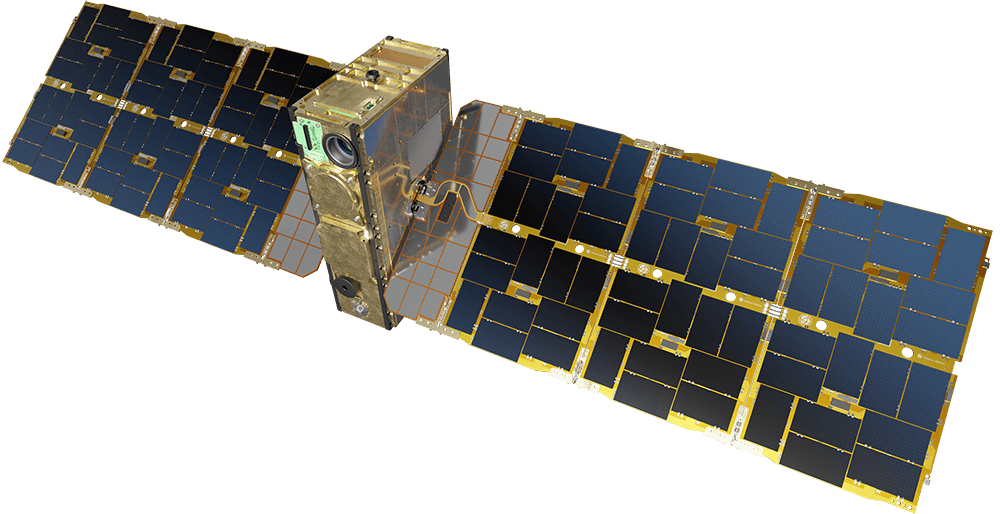
MILANI is a 6U satellite specifically created for the European Space Agency by Tyvak International in Torino, together with a consortium of partner companies, universities, and research institutes from Italy, Finland, and the Czech Republic. MILANI was appropriately named after the Italian mathematician and astronomer Andrea Milani, a leading figure in Europe’s space science community, and a pioneer of asteroid risk analysis.
In a launch scheduled for 2024, MILANI will be carried by the HERA mothercraft and will take 3 years to travel from Low Earth Orbit to the Didymos binary system of asteroids. Expected to reach the asteroids in 2027, MILANI will be deployed to survey the surface with a hyperspectral imager combining visible and near infrared wavelengths to survey the surface of the asteroids. It also will carry an Italian built dust detector capable of detecting tiny dust particles, volatiles, and light organic matter, characterizing the molecular composition of the larger asteroid bodies.
Hera is a planetary defense mission under development at the European Space Agency (ESA) – launching in October 2024. Its objectives are to investigate the Didymos binary asteroid, including the very first assessment of its internal properties, and to measure in great detail the outcome of NASA’s DART mission kinetic impactor test. Hera will provide extremely valuable information for future asteroid deflection missions and science; increasing our understanding of asteroid geophysics as well as solar system formation and evolutionary processes.
The Hera mission will also deploy the Milani 6-unit CubeSat. Its main instrument will be the ASPECT hyperspectral imager, combining visible and near infrared wavelengths to survey the surface down to a maximum spatial resolution of 1 m. It will also carry VISTA,an Italian-built dust detector. The instrument is devoted to detecting the presence of dust particles smaller than 5-10 µm, detecting volatiles and light organics characterization, and monitoring the molecular contamination in the surrounding of Mliani.
Milani is a CubeSat developed by Tyvak International Srl, devoted to the visual inspection and dust detection of Didymos asteroid following DART impact.
Main scientific objectives:
- Map the global composition of the Didymus asteroids
- Characterize the surface of the Didymus asteroids
- Evaluate DART impact effects on Didymos asteroids and support gravity field determination
- Characterize dust clouds around the Didymos asteroids
A Deep Impact
-
NationEurope
-
ApplicationAsteroid Flyby
-
OperatorESA
-
Configuration6U Satellite
-
Launch DateOctober 2024
-
Launch VehicleAriane-62 Astris
-
Mission LengthN/A
-
Mission CompletionN/A
 Image Credit: Esa
Ariane-62 Astris
ArianeGroup and the European Space Agency are carrying out preparations for the maiden launch of the Ariane 6 rocket next year. Ariane 6 represents the next generation of the Ariane family of rockets, intended to allow its customers lower-cost access to space. The rocket and launch pad still have an extensive test program ahead of them, with a current target launch date in the second half of 2022.
Ariane 6 is the sixth member of the Ariane family of rockets, whose development began in the 1970s to allow the ESA (European Space Agency) to place its own satellites–and commercial payloads–into geostationary orbit. From 1979 to 2003, the Ariane 1, 2, 3 and 4 rockets launched 144 times with 137 successes.