
Tranche 0
Space development agency tranche 0 transport layer
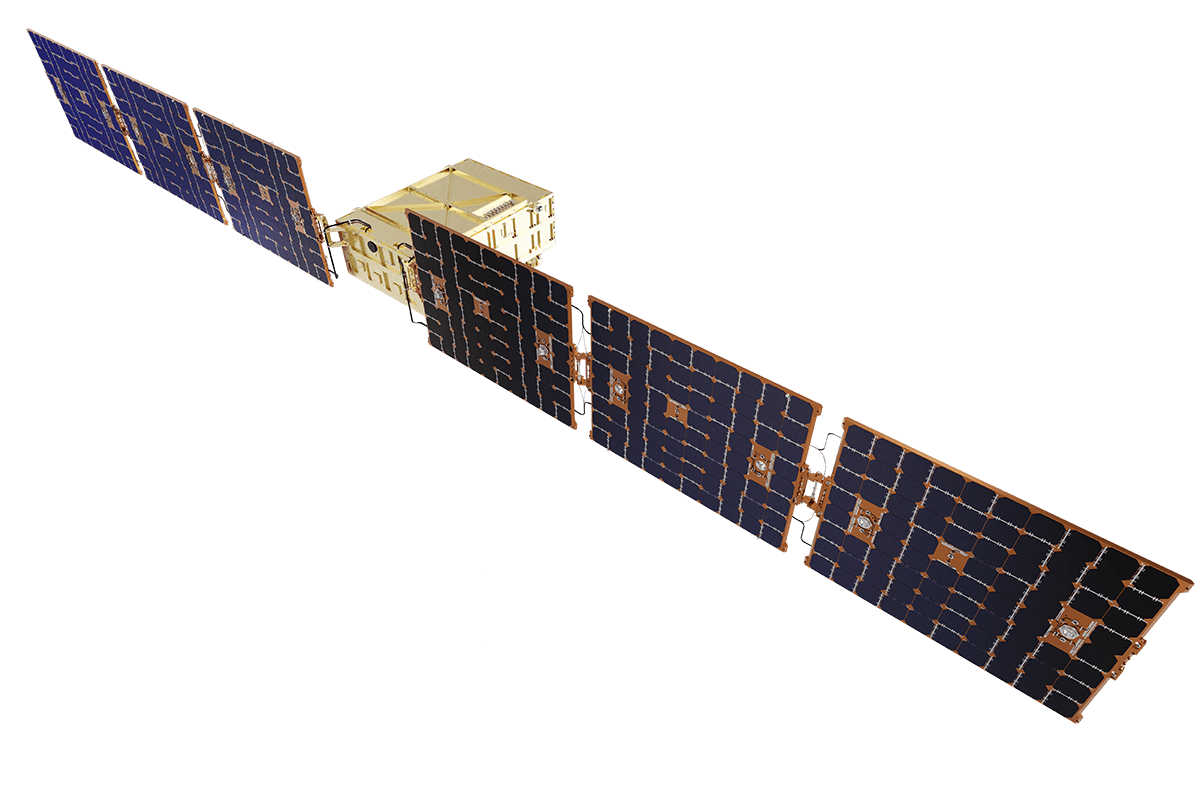
The Beyond-Line-Of-Sight Targeting And Communications Satellites
Terran Orbital is designing and building ten satellite buses for Lockheed Martin in support of the Space Development Agency’s Tranche 0 Transport Layer. The Tranche 0 spacecraft are built on Terran Orbital’s Zuma Platform, a micro-sat class spacecraft that leverages the MKII Avionics platform, typical to the Trestles platform.
The Tranche 0 foundation layer represents the initial step in building an interoperable, connected, secure mesh network. Once in orbit, Tranche 0 will demonstrate Joint All-Domain Operations capabilities by linking nodes together and creating seamless connectivity between all domains.
SDA’s Transport Layer will provide assured, resilient, low-latency military data and connectivity worldwide to the full range of warfighter platforms. The Transport Layer is exploring technical areas including, but not limited to:
- Optimized control of modulation techniques (including wide-band or narrow-band operations),
- Simultaneous transmit and receive technologies,
- Communications security functions (e.g., frequency hopping),
- Unique state-of-the-art waveforms,
- Space implementation of tactical data links,
- Automated dynamic networking and routing techniques,
- Commercial cryptographic systems,
- Blockchain technologies,
- Multiband phased array antennas, and
- Multi-level security (MLS).
Security Now, Not "Soon"
-
NationUSA
-
ApplicationCommunications, Laser
-
OperatorSDA
-
ConfigurationUnder 500kg
-
Launch Date2 April, 2023
-
Launch VehicleSpace X Falcon-9
-
Mission LengthN/A
-
Mission CompletionN/A
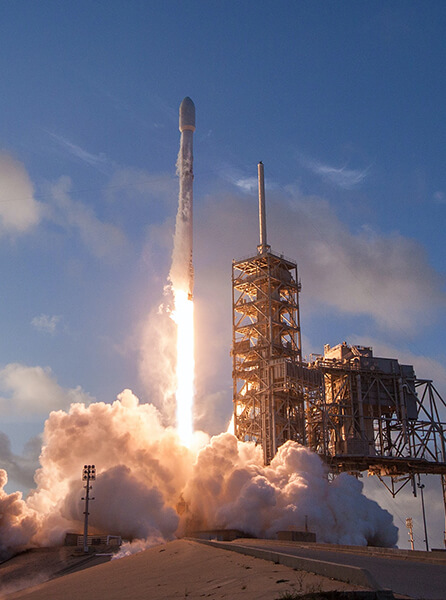 Image Credit: SpaceX on Unsplash
Space X Falcon-9
Falcon 9 is a rocket that can carry cargo and humans into Earth’s orbit, even reaching the International Space Station (ISS). It is produced by American aerospace company SpaceX. Technically, it is a partially reusable, medium lift launch vehicle.
The rocket has two stages. The first (booster) stage carries the second stage and payload to a certain altitude, after which the second stage lifts the payload to its ultimate destination. The rocket evolved through several versions. V1.0 flew from 2010–2013, V1.1 flew from 2013–2016, while V1.2 Full Thrust first launched in 2015, encompassing the Block 5 Full Thrust variant, flying since May 2018.
The booster is capable of landing vertically to facilitate reuse. This feat was first achieved on flight 20 in December 2015. Since then, SpaceX has successfully landed boosters over 100 times. Individual boosters have flown as many as thirteen flights. Both stages are powered by SpaceX Merlin engines, using cryogenic liquid oxygen and rocket-grade kerosene (RP-1) as propellants.
The heaviest payloads flown to geostationary transfer orbit (GTO) were Intelsat 35e carrying 6,761 kg (14,905 lb), and Telstar 19V with 7,075 kg (15,598 lb). The former was launched into an advantageous super-synchronous transfer orbit, while the latter achieved a lower-energy GTO achieving an apogee well below the geostationary altitude.