
LunIR
Mapping The Lunar Surface
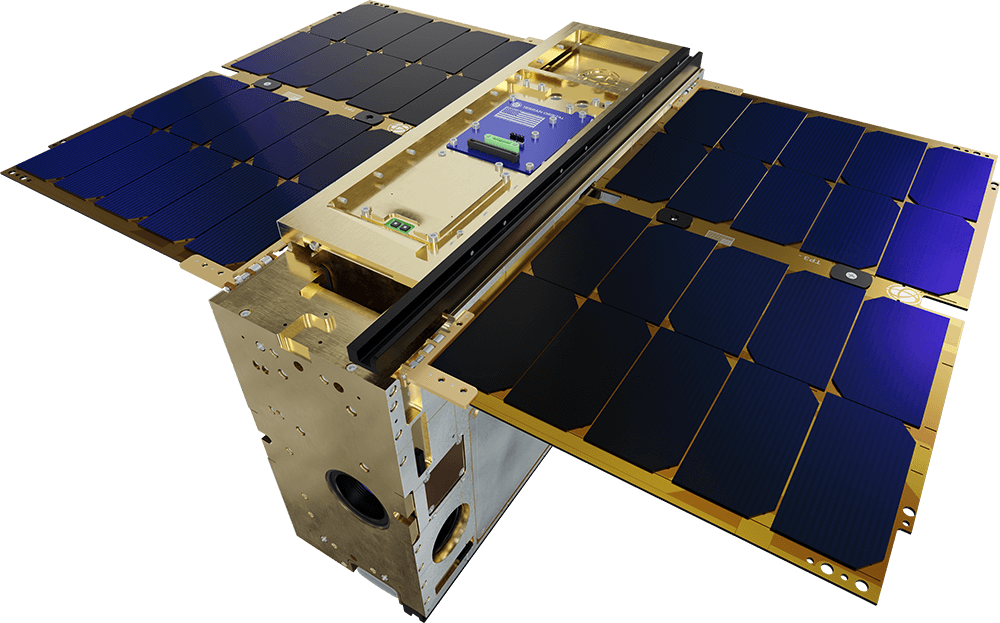
LunIR is a NASA-funded satellite built by Terran Orbital and Lockheed Martin to collect lunar images and gather data after piggybacking on NASA’s Space Launch System rocket Artemis 1 uncrewed moon mission. LunIR will deploy from the SLS rocket’s Orion stage adapter. Lockheed Martin developed LunIR’s infrared sensor and cryocooler to operate day and night, mapping the lunar surface, detecting materials, and identifying potential landing sites. Terran Orbital designed, built, and integrated the spacecraft and is responsible for mission assurance.
Lunar InfraRed Imaging (LunIR), formerly known as SkyFire, is a 6U satellite designed to perform a lunar flyby followed by a deep space technology test to address questions related to transit and long-duration missions. The primary objectives of the mission are to address strategic knowledge gaps (SKGs) for surface characterization, remote sensing, and site selection observations for the Moon, and SKGs for long-duration missions to Mars. The primary mission goal is to collect data that will enable future risk reduction for crewed missions.
Moon Mapping
-
NationUSA
-
ApplicationLunar Flyby
-
OperatorLockheed Martin
-
Configuration6U Satellite
-
Launch Date16 November 2022
-
Launch VehicleNASA SLS
-
Mission LengthN/A
-
Mission CompletionN/A
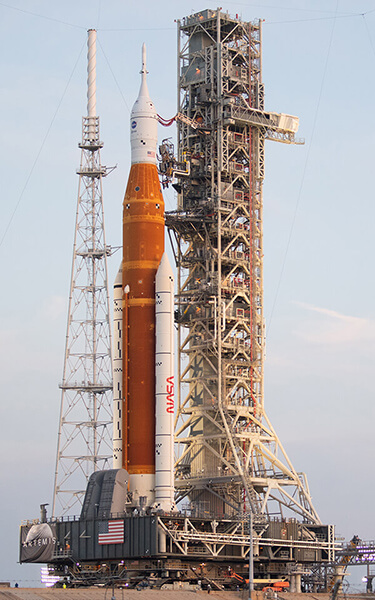 Image Credit: NASA/Joel Kowsky
Artemis 1
Artemis 1 uses the Block 1 variant of the Space Launch System. The Block 1 first stage consists of a core stage and two five-segment solid rocket boosters (SRBs). The core stage reuses four RS-25D engines that had flown on the Space Shuttle. The core and boosters together produce 39,000 kN (8,800,000 lbf) of thrust at liftoff. The upper stage Interim Cryogenic Propulsion Stage (ICPS) is based on the Delta Cryogenic Second Stage (itself based on the design of the upper stage of JAXA’s H-IIA and former H-IIB launch vehicles), containing one RL10 engine.
Once in orbit, the ICPS will perform a trans-lunar injection (TLI) burn, which will transfer the Orion spacecraft and 10 CubeSats on the way to the Moon. The Orion will separate from the ICPS and coast to lunar space. The Stage Adapter on ICPS will deploy 10 CubeSats that will do scientific research and perform technology demonstrations.
Originally, the mission was planned to follow a circumlunar trajectory without entering orbit around the Moon. Current plans are expected to have the Orion spacecraft spend approximately three weeks in space, including six days in a distant retrograde orbit around the Moon.